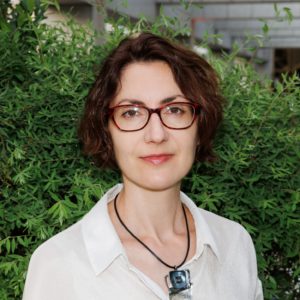
For Latvian artist Evija Freidenfelde, art is a way of looking at the world — one that pays close attention to often invisible processes and to the information embedded in things, materials, organisms, and environments. Her research-based practice brings together painting, drawing, printmaking, and experimental techniques. She explores how memory is formed and transformed through encounters between different carriers of information. At the centre of her practice is an evolving body of work she calls Memory Field. Freidenfelde understands memory not as a definitive record of the past, but as an active process that continues to unfold in the present.
“I think the most important thing for me is how I feel in the world around me and how I perceive it,” she says.
Her path to becoming an artist, however, was far from linear. Before turning to art professionally, Freidenfelde earned advanced degrees in biology and law and worked in both fields, spending several years as a biologist before going on to work as a prosecutor for 25 years. Throughout this time, art remained a constant in her life, initially as something private: “Art was always there, almost like a hobby — something I could turn to in order to rest and express myself.”

Evija Freidenfelde, Planetary Memory, triptych, 2024

Evija Freidenfelde, Vidzeme Landscape, 2024
The decision to pursue art professionally came later. Between 2017 and 2021, Freidenfelde studied graphic art at the Art Academy of Latvia, earning a professional bachelor’s degree, followed by a Master of Arts there in 2023. Returning to education later in life allowed her to approach art with the experience of several previous disciplines behind her. “The way I look at the world is connected to those former professions,” she explains.
Biology, in particular, continues to shape her understanding of the world. “I always feel that the world around us is alive, that it breathes and carries very important information,” she says. “We cannot simply exploit the world and everything living around us. We are only a part of it.” Her legal background contributes another dimension: a habit of investigating, examining evidence, and looking beneath the surface. Together, these experiences have led her away from an illustrative approach towards a practice concerned with processes and relationships.
“I am not interested in illustrating what I see,” Freidenfelde says. “I am interested in going deeper into processes.”
This investigative impulse lies at the heart of Memory Field. “Human memory is inherently subjective, shaped by personal experience, education, emotion, and individual history,” she says. “I’m interested in forms of memory that exist beyond the individual — in landscapes, architecture, materials, organisms, and space.”
Memory, in this sense, is not an archive containing a completed record of the past. It is something that happens through interaction: “When a person or two objects interact with each other, an exchange of information takes place, and new information appears.”

Evija Freidenfelde, Across the River, from the Urban Deja Vu series, 2025
This understanding expands Memory Field beyond any particular geographical location. Her works may evoke cities or landscapes, but they are not intended to depict specific places. A fragment of architecture might recall Rome or New York to a viewer, yet the association is ultimately subjective. What matters to Evija Freidenfelde is the accumulation of information contained in the material itself — layers of past, present, and potential future. “Architectural forms and materials also contain memory,” she says. The same principle applies to natural systems. Freidenfelde thinks about the exchange of information between trees and fungi, between sand and water in a river, or between river water and ocean water.
Her relationship with materials follows the same logic. Graphite, charcoal, pigments, Chinese ink, printmaking ink, water, paper, canvas, and textiles are not passive instruments used to execute a predetermined image; they help shape the final work. “These media that I work with are also my coauthors,” Freidenfelde says. “I interact with the materials, and sometimes I cannot predict what the result will be.” Pigment reacts with water; ink spreads; graphite and charcoal leave traces; surfaces absorb, resist, erase, or transform what has been placed upon them.
The unexpected marks, textures, fields, and movements that emerge during this process are not errors to be corrected, they are essential to her work. They also make repetition impossible: “I cannot make two identical works. It will always be different because so much depends on things that are outside my control.”
Freidenfelde expresses this balance between control and unpredictability through her visual language. Her palette is predominantly black, white, and grey, occasionally interrupted by cobalt blue, red, or burgundy. For her, black and white are not synonymous with restraint or absence. “I think monochrome can be very vivid,” she says. “Sometimes I make a black-and-white work and think, how bright it is, even though there are only two or three colors.”

Evija Freidenfelde, Cube, 2023
Certain signs recur throughout her works. Among them are intersecting lines that form a cross-like shape, with a point at their centre. Freidenfelde is careful to distinguish this from an iconographic or religious cross. For her, it represents a point of encounter: “Where the lines intersect, something happens. It becomes a kind of focal point.”
The recurring lines also relate to another central idea in her work: the apparent emptiness of the space around us. “It seems as if there is nothing in the air,” she says, “but this emptiness is actually full of tension. What appears empty may instead be saturated with processes that remain invisible to us.”
This is perhaps where the different strands of Memory Field converge. Memory exists in human experience, but also in matter, architecture, landscapes, organisms, and the relationships between them. It is simultaneously visible and invisible, fixed and constantly changing. In her works, each layer records an action, while subsequent layers alter, obscure, or reactivate what came before. Even removal and masking can leave traces. Even disappearance leaves a trace. The material carries the history of its own transformation. In this sense, Memory Field is both a subject and a method. The artist creates the conditions for materials to interact, observes what happens, and makes decisions while leaving room for the unexpected.