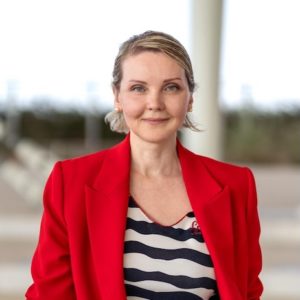
Returning from the opening of the 61st Venice Biennale, art critic and co-founder of 300Magazine Julia Sysalova reflects on Personal Structures, a parallel exhibition program to which she contributed as a curator.
During the Venice Biennale, public attention usually focuses on the national pavilions. But many of the most interesting artistic conversations happen beyond the official route — in parallel exhibitions and independent platforms. One such platform is Personal Structures, an international exhibition initiative organized by the European Cultural Centre (ECC) and held alongside the Venice Biennale.
In 2026, the project’s theme is Confluences, inviting audiences to consider art as a space where disciplines, memory, technologies, geographies, and identities intersect. More than 175 artists from over 40 countries contribute to a multilayered dialogue about contemporary reality.
Originally founded in 1998 by Dutch artist René Rietmeyer as a long-term research initiative, Personal Structures evolved through exhibitions and philosophical symposia into an international platform connecting art, architecture, critical theory, and research practices.
The first exhibition and symposium took place in 2005 at the Ludwig Museum in Koblenz, Germany. Over time, the project has become a stable international platform where artistic installations coexist with research, architectural practices, and conceptual investigations. Since 2011, Personal Structures has been part of the Venice Biennale collateral events program.
Unlike the official Biennale, traditionally structured around national representation, Personal Structures emphasizes individual artistic voices, hybrid methodologies, and interdisciplinary intersections. This makes it especially relevant for artists and curators engaging with themes of identity, memory, political sensitivity, and cultural transformation.
Platforms like these tend to capture shifts in artistic thinking faster than official institutions, because they operate through research-based practices.
In 2026, the project further expands through PS Design, a new direction exploring the convergence of art, design, and experimental research.
What makes Personal Structures unconventional is not only its curatorial concept, but also the way the exhibition is spread across different locations in Venice. Each venue creates its own atmosphere and changes the way visitors experience the artworks.
My curatorial project, Crosslines: Unlocked Identities, is exhibited at Palazzo Bembo, a historic palace on the Grand Canal and one of the project’s central venues, presenting exhibitions focused on contemporary visual languages.
Palazzo Mora offers a more experimental setting, where historic interiors are combined with installations and interdisciplinary projects. At Marinaressa Gardens, artworks are placed in an open public space and become part of the everyday life of the city.
Points of Intersection
The 2026 theme explores how different worlds and identities increasingly overlap and influence one another. In a time of migration, digital technologies, and constant social change, fixed boundaries no longer seem stable or sufficient. So art becomes a way of capturing states of transition between the personal and the collective, the physical and the digital, memory and imagination.
Within Personal Structures 2026, I present the curatorial project Crosslines: Unlocked Identities, which looks at identity as something formed through emotional, cultural, physical, and digital connections.
While working on the project, I began to think of identity less as something fixed and more as a process of constant transformation. Today, the ability to change while still preserving an inner sense of self may be one of the most important forms of resilience.
The exhibition brings together four artists, each exploring identity in a different way: through archetypal stories of transformation, the body, inner psychological spaces, and constructed cultural images.
Natalya Raduenz: Internal Transformation
Raduenz’ works approach identity not as a stable condition but as a gradual process of internal displacement.
“For me, Crosslines is a project about the internal moments in which a person quietly changes themselves. In the She Could Fly series, I work with crossroads in women’s lives—moments of vulnerability, loss, choice, and trust that remain within us and continue shaping who we become years later. Personal experience, cultural memory, and inner transformation become spaces of dialogue, where each work offers its own trajectory of human formation.”

A work by Natalya Raduenz
Veera Romanoff: Identity Under Pressure
Veera Romanoff examines identity as a condition of sustaining form under pressure.
“I do not depict the body, I think through it. Crossline is a series of three works in which transformation is not a singular event, but a sequence of threshold states, each requiring its own mode of perception. I work with the body in tension between performativity and presence. The figure holds its inner world together against disintegration, remaining in a state of extreme resistance. In these works, the body acts as a force entering into conflict with its own form: it breaks through its shell, disrupts boundaries, and resists fixation.”

A work by Veera Romanoff
Alena Rezanova: The Inner Architecture of Identity
“In my work, I explore identity as an unstable internal architecture, continuously reconstructed through memory, experience, and internal conflict. I am interested in the moment when previous coordinates of the self cease to function while new ones have not yet taken shape. For me, Crosslines is a transitional space where transformation becomes not destruction, but a way of assembling oneself anew.”
A work by Alena Rezanova
Alina Altukhova: Cultural Projections and the Construction of Identity
“Through the image of Barbie, I address the ways mass culture shapes ideas about identity, success, femininity, and desirable futures. I am interested in the boundary between authentic identity and the roles society encourages us to adopt. Within the context of Crosslines, I view identity as the result of continual collisions between personal experience, collective memory, and cultural projections.”

A work by Alina Altukhova