In September 2025, conceptual artist Elisaveta Sivas presented her digital installation See Through the Eyes of the Creator at Decentraland Art Week 2025 — one of the leading global events celebrating digital art and metaverse culture. Her work was selected among the 20 winning artist projects worldwide, showcased during the festival, and realized with the support of Vegas City Studio.
The installation invites viewers to step inside the mind of the Creator and experience reality from a divine perspective — a concept that Elisaveta has been developing for several years. This idea took on a defined philosophical and curatorial form during her studies at the School of Art Communications, founded by Julia Sysalova, where, under Julia’s mentorship, she refined and expanded the framework of her long-term project Heads of the Creator.
In the following conversation, Julia and Elisaveta discuss the experience of creating art entirely within the virtual realm, reflecting on how spirituality, consciousness, and form can transcend physical boundaries, and what new horizons the metaverse opens for conceptual and public art.
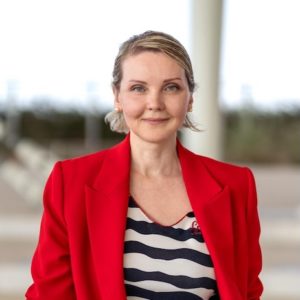
Elisaveta Sivas is a conceptual artist based in Estonia whose practice spans painting and sculpture. Rooted in spirituality, conscious living, and the study of human nature, her work combines minimalist form with symbolic depth. With a background in Modern Greek and Byzantine Studies and a PhD in Theoretical Linguistics, Elisaveta brings a philosophical and analytical dimension to her artistic process. Her training includes fashion and theatrical costume design, ceramics, and studio work. Her art has been shown in numerous solo and group exhibitions and is held in private collections across Europe, North America, the Middle East, and Asia.
At Decentraland Art Week 2025, you found yourself working in a fully immersive, decentralized environment. What did you find to be the most revealing or transformative aspect of creating and presenting art in this purely digital context?
The most striking revelation was how real the virtual world feels. Inside Decentraland, the avatar can see, hear, and interact — it’s a reality with its own colors, sounds, and vibrations. Though not entirely physical and slightly dreamlike, it feels tangible. This environment made it possible for me to create a large-scale transparent head through which the surrounding world remains visible, merging with the world within. Realizing such an idea in the physical world would be complex and costly, but in Decentraland’s virtual space, I could give the project new freedom and depth while preserving its original spiritual essence.
Coming from a background in conceptual sculpture, how did working without physical matter influence your understanding of form, space, and presence?
Working without physical matter didn’t change the essence of my process. It is still about working with three-dimensional form, which I always first see in detail in my imagination and then realize physically or virtually. Of course, the physical touch is missing in the metaverse, but the sense of presence and the perception of space and shape remain the same.

Elisaveta Sivas. See Through the Eyes of the Creator
As this was your first encounter with the metaverse, how did the process of digital creation compare to the tactile experience of building sculptures? Did you encounter any moments of unexpected freedom or limitations you hadn’t anticipated?
There is definitely a difference: in physical sculpture, you can feel the properties of the material, its density, flexibility, and texture. In the metaverse, that tangible sensation is absent, but in exchange, there is a kind of freedom impossible in the physical world. The most unexpected part was how real and alive the virtual environment feels. I also had to learn to think not only as a sculptor but as a metaverse designer: to understand how interactivity works, how characters move, and what technical possibilities Decentraland offers. This new way of thinking expanded my artistic vision, as I had to adapt the steps of the spiritual path to the technical constraints and functionalities of Decentraland.
Your practice often carries a meditative and spiritual dimension. How did the digital realm influence or transform the contemplative aspects of your work and your own creative state of mind?
For me, the digital realm became a new medium for guiding people through a spiritual experience. Inside the head, the viewer enters a journey of awakening, reconnecting with the body, clearing blocks, activating inner powers, and learning to create from within. Even though the experience is virtual, it evokes deep emotional and meditative states. The images, colors, sounds, and effects help guide the viewer through this process.
The transparency of the head, which allows viewers to see the outside world from within, was a new element compared to my clay sculpture, and I find it very meaningful. It creates a powerful sense of unity between the inner and outer worlds. The process of creating the project itself was deeply meditative. I was constantly balancing between the realms of matter and energy.
Elisaveta Sivas. See Through the Eyes of the Creator
The metaverse is not only a medium but also a social and philosophical experiment. What did you observe about audience behavior and interaction with your work in this environment, and did it change how you think about the role of the viewer?
In the metaverse, the viewer is no longer just an observer, nor merely a participant. They become a full co-creator of the experience, a true creator of their own reality. This is the essence of my project: to immerse people inside the Creator’s head, to let them feel what it means to be the Creator, to merge with the artwork, and to create from within.
I noticed that interaction in the digital space helps people open up more easily. They explore, play, and feel safe to express themselves.
After this experience, how do you envision integrating digital tools and virtual spaces into your future projects? Do you see them as a parallel path to your sculptural practice, or as something that could transform it more profoundly?
I see it as both a parallel path and a transformative one. My concept of the Creator’s head will continue to evolve across different formats — physical, digital, and hybrid. The metaverse offers tools that expand the possibilities for interaction, sound, light, and movement, which I plan to explore in future projects. Digital art doesn’t replace sculpture; it deepens it, adding new layers of meaning and experience. I believe it gives us another way to explore unity, awareness, and conceptual art.