
Censorship and Controversy of Ilya Repin’s Painting of Ivan the Terrible
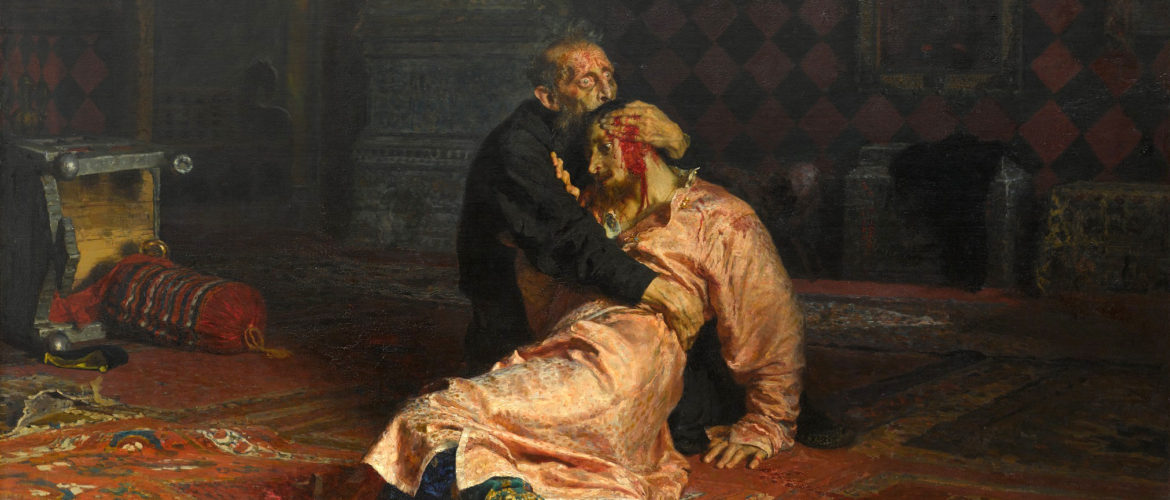
Ilya Repin’s painting of Ivan the Terrible and his son Ivan is one of the brightest examples of controversial and unsettling Russian art. The image of Ivan the Terrible, a cruel tyrant and a desperate father in one person, is memorable and dramatic, leaving a long-lasting emotional impression on viewers. Yet, the painting’s notoriety doesn’t stem solely from its dramatic depiction of a tragic event; its symbolism and meaning have gone far beyond. This work embodies the complex cultural fabric of views on political power, history, and national identity.
The Imperial Ban on Displaying Ilya Repin’s Painting of Ivan the Terrible
As soon as Ilya Repin completed the painting of Ivan the Terrible in 1885, its reception was immediately controversial and negative. The Russian Empire was going through a challenging period after Alexander II’s assassination in 1881, and the then-ruler, Alexander III, was conscious of any potential threats to imperial autocracy.
Repin’s complex and multi-dimensional depiction of a murderous tsar touched the strings of the imperial family’s superstition, triggering a ban on its display. The official version for that ban was Repin’s intentional distortion of Russian historical events. In reality, however, the imperial elite feared that the painting’s emotional intensity could trigger unwanted associations between Ivan the Terrible’s violence and paranoia and the present-day unstable imperial rule.
Repin’s Painting as a Symbol of Suppressed Memory
Though censorship and display ban efforts were intended to mute the political resonance of Repin’s painting, the effect was completely opposite. Historians note that Repin’s art served as a political lightning rod to fuel public discontent and trigger fundamental shifts in the public psyche of the late 19th century.
“Ivan the Terrible and His Son Ivan” became a symbol of the imperial government’s attempts to shape and control the representations of the political past and present. It embodied the human costs of centralized power and the harms inflicted on the nation by violent imperial rulers. However, the rhetoric around this painting changed during the Soviet period, with USSR think tanks trying to reframe Ivan IV’s image as a consolidator of state power.
The Painting’s Fate in the 21st Century
Despite numerous shifts in the interpretation of Repin’s masterpiece, this monumental painting has remained a precious part of the Tretyakov gallery’s collection on display. It suffered an attack by a gallery visitor in 2018, with serious damage to the frame and canvas, proving that its impact on the Russian national identity and psyche persists.