
The Fascinating Life and Photographic Work of Gordon Parks

Most people who think of Gordon Parks immediately picture him with a camera. It’s a natural association, as Parks’s photographs documenting segregation, poverty, and Black life in mid-20th-century America remain among the most recognizable images in American history. However, reducing Gordon Parks’s legacy to photography alone would be a significant understatement.
Gordon Parks’s Most Famous Photos
Gordon Parks was born in 1912 in Kansas as the youngest of fifteen children in an African American family. Largely self-taught, he mastered many artistic disciplines despite having no access to formal education. In his early twenties, he bought his first camera from a pawnshop and soon began creating powerful photographs that combined artistic sophistication with social commentary.
His work documented segregation, discrimination, and labor inequality while drawing inspiration from the visual language of classical art and romanticized Americana. One of Gordon Parks’s best-known photographs is American Gothic, Washington, D.C. (1942), portraying Ella Watson standing before an American flag with a broom and mop (featured, detail). The image became an enduring symbol of racial inequality and demonstrated the extraordinary storytelling power of photography.
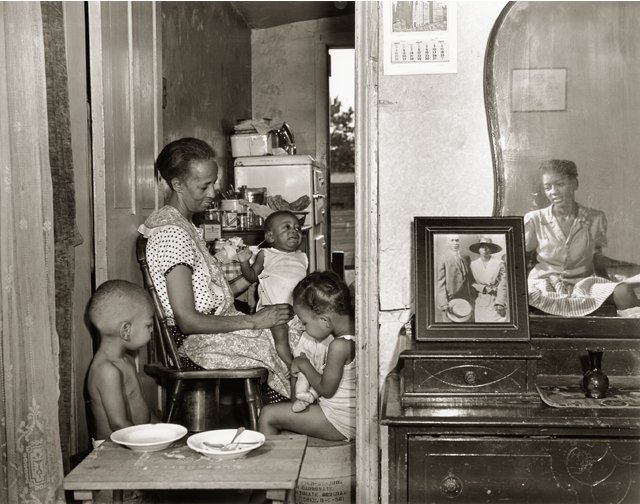
Washington, D.C. Mrs. Ella Watson, a government charwoman, with three grandchildren and her adopted daughter. Gordon Parks’s FSA series.
Gordon Parks as a Film Director
Photography was only one part of Parks’s remarkable career. He also became an accomplished filmmaker. His 1969 film The Learning Tree, based on his semi-autobiographical novel about a Black boy growing up in Kansas, made Gordon Parks the first Black director to helm a major Hollywood studio production.
He followed it with Shaft in 1971, a landmark film that helped define the Blaxploitation genre while proving that stories centered on Black characters could achieve mainstream commercial success. Although these two films differ greatly in tone and style, both reflect Parks’s commitment to portraying authentic Black experiences and expanding representation in American cinema.
Musical and Literary Contributions
Gordon Parks’s musical achievements receive less attention but remain an important part of his artistic legacy. He composed a piano concerto and later created the ballet Martin in honor of Martin Luther King Jr. Despite lacking formal musical training, Parks produced thoughtful classical works through determination and creative vision.
Parks was also an accomplished writer. Along with The Learning Tree, he published the acclaimed memoir A Choice of Weapons and several poetry collections. In many cases, he paired his poems with his own photographs, creating an even more powerful emotional and visual impact.
The remarkable versatility of Gordon Parks—as a photographer, filmmaker, composer, and writer—makes him one of the most influential figures in modern American culture. His enduring legacy continues to inspire generations through both artistic excellence and his unwavering commitment to social justice.