From “Obey” to “Hope”: The Evolution of Art by Shepard Fairey

Shepard Fairey is a contemporary American artist and activist. He is best known for the OBEY sticker campaign and the iconic “Hope” poster created for Barack Obama’s 2008 presidential campaign. This article explores the creative trajectory of Fairey, tracing the evolution of his distinctive visual language and the development of the artistic philosophy behind his work.
The Obey Giant Sticker by Shepard Fairey
Shepard Fairey’s rise to fame began in 1989 while he was teaching a friend how to cut a stencil at a Rhode Island skate shop. At that moment, he noticed a newspaper photo of the famous wrestler André the Giant. The image inspired a bold, high-contrast portrait paired with the phrase “André the Giant Has a Posse,” which became Fairey’s personal project during his studies at the Rhode Island School of Design.
While not originally intended as a traditional artwork, the sticker quickly spread through public spaces as a striking intersection of graffiti, pop art, and political propaganda. Long before social media existed, the stickers circulated organically through human networks, eventually appearing in more than 40 countries. Legal concerns later prompted Fairey to redesign the image and replace the original text with a single word—OBEY—creating the now-famous Obey Giant icon.
The restyled image crystallized Shepard Fairey’s recognizable visual language, combining bold red, black, and cream colors. This aesthetic emerged from a fusion of Soviet Constructivism, Cold War propaganda graphics, pop art, and skateboard culture. The word OBEY itself was borrowed from John Carpenter’s 1988 film They Live, which explored the concept of subliminal messages hidden within everyday society.
The “Hope” Poster of 2008
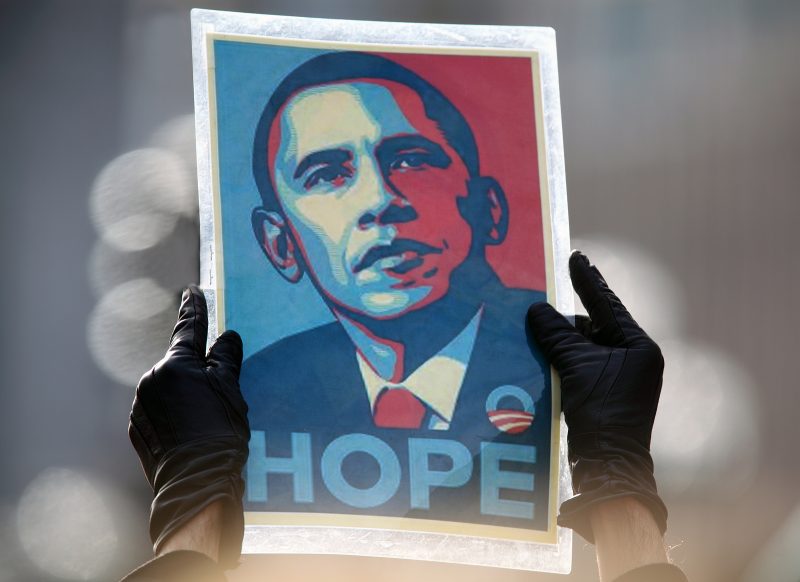
The OBEY aesthetic had circulated within subcultures for years before Shepard Fairey transformed a 2008 Associated Press photograph of Barack Obama into his signature red, blue, and cream palette, adding the word “Hope.” The image quickly became the unofficial visual symbol of Obama’s presidential campaign and is now part of the Smithsonian’s National Portrait Gallery collection.
Many experts believe the success of “Hope” reflected both the political atmosphere of 2008 and Fairey’s ability to combine parody, activism, and the authority of political imagery into a powerful visual statement. The portrait inspired millions of Americans and remains closely associated with optimism, change, and the promise of political transformation.
Shepard Fairey’s Street Art Today
Today, Fairey continues to build on his well-established visual grammar while remaining committed to activism. Notable recent works include the 2017 We The People series, featuring portraits of women created in support of the Women’s Marches. With an auction record of $950,000, Fairey remains one of the most influential contemporary street artists, whose work continues to shape conversations about politics, culture, and the role of public art around the world.