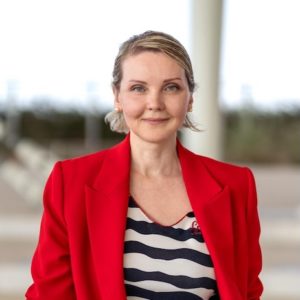
Based in Athens, artist and curator Artemis Potamianou examines how art history and the structures of the art world shape what we see, remember, and value. Working across installation, photography, video, and appropriation, she revisits familiar images and narratives, drawing attention to perspectives that have often been overlooked.
Alongside her artistic practice, Artemis Potamianou has curated more than 60 exhibitions featuring artists such as Joseph Kosuth, Joseph Beuys, Damien Hirst, and the Guerrilla Girls. She is also the founder and director of Platforms Project, an international art fair for independent artistic initiatives. Her work has been shown at exhibitions and biennales around the world and is held in the permanent collections of institutions including the National Museum of Contemporary Art (EMST) in Athens and the Benetton Foundation.
Who gets to become part of art history? The answer is shaped long before a work enters a museum, through exhibition programs, critical judgments, and market forces. Artemis Potamianou brings these mechanisms to the fore, inviting us to look more closely at how artistic value is defined and whose contributions remain overlooked.
What draws me to her practice is the way she makes these questions tangible. Familiar images take on new meanings when placed alongside unexpected counterparts; the museum becomes something to question rather than take for granted; and the cage blurs the line between protection and control. Her work asks us to reconsider the narratives through which we understand art and art history, particularly those that have cast women as muses or models while overlooking their agency as artists.
In this interview, we discuss the authority of museums, the possibilities and limits of revisiting the canon, and the challenge of maintaining independence as a platform grows. Running through her answers is a question that I find essential to curatorial practice: what might become visible if we allowed ourselves to look again at what we think we already know?

In your practice, art often becomes a way of investigating art itself: the museum, the canon, the artist’s status, institutional power, and the mechanisms of recognition. What interests you most today: making a work of art or examining the system that decides what ultimately counts as art?
For me, the two cannot really be separated. I am interested in making a work, but I am equally interested in understanding the context in which it acquires meaning, value, and visibility. As early as Barcode in Tate (2001), I was interested not only in the artwork but also in the mechanisms surrounding it: the museum, classification, authority, and the idea of institutional validation. The barcode itself is a simple, recognizable coding system, bringing the logic of inventory and commercial classification into the museum. I was interested in a hypothetical scenario that included instructions for installing the work at Tate Modern, and in whether the public might find that scenario credible.
Art can examine the very conditions of its own existence. Who decides what matters? Who is given space, who is given a voice, who enters history, and who remains invisible? These questions return in different forms throughout my work. This may also be where my different roles intersect. As an artist, I want to explore these issues through artworks. As a curator, I am interested in how works enter into dialogue and encounter their audiences. So I would not say that the system matters more to me than the work. I see the work as a way to engage with that system, observe how it operates, and perhaps shift its boundaries a little.
With Barcode in Tate (2001), you were already questioning the museum’s role and the mechanisms of institutional validation. More than twenty years have passed since then. Has the nature of power in the art world changed? Who has the greatest influence on artistic value today: museums, the market, curators, collectors, or audiences?
A great deal has changed over the past twenty years, but I do not think power in the art world has simply moved from one player to another. It has become more complex and more distributed. Museums, the market, curators, collectors, artists, the media, and now digital platforms all participate in shaping value.
What is interesting is that visibility can be generated very quickly today, but it can disappear just as quickly. Social media, for example, has created new ways to communicate and present ourselves, while also introducing new mechanisms of evaluation. If I had to identify a single factor, I would say that the greatest power ultimately lies in the relationships among all these players. Value is not produced by one institution alone. It emerges from a network of relationships, decisions, narratives, and economic mechanisms. And because that network is not fixed, it can also be challenged.

Artemis Potamianou, Barcode in Tate
Your work maintains an ongoing dialogue with art history: you reference iconic works, dismantle established associations, and reconfigure them in new ways. What is art history to you: a legacy an artist engages with or material that each new generation of artists has the right to rewrite?
For me, art history is both a legacy and a living material. We cannot create as though nothing came before us, but neither are we obliged to accept inherited interpretations as definitive. I am particularly interested in taking a work or a story we think we know and looking at it from a different perspective. Sometimes, looking at something differently is enough to reveal what was there all along but had gone unnoticed.
In the Re-view series, for example, I use the associations that artworks evoke as artistic material in their own right. By removing familiar figures from their original settings and bringing them together in unexpected combinations, I create new narratives and propose a different reading of art history. I’m interested in how familiar images can take on new meaning when we look at them in a different way.
Another approach appears in the installation Second Papers (2006), in which twelve replicas of iconic twentieth-century works form an imagined museum of memory. Their arrangement in space, together with threads that reference Marcel Duchamp’s First Papers of Surrealism and obstruct the viewer’s passage, creates a kind of inaccessible zone within art history. The installation raises questions about authenticity and the uniqueness of the artwork, but also about what ultimately gives it artistic value: its material existence or the memories and associations it activates?
In both cases, I am interested in using works we consider familiar to create the conditions for seeing them anew, rather than simply confirming their place in history. I do not think each new generation should “rewrite” art history in the sense of erasing what came before. Rather, I believe we have a responsibility to reread it. Art history is not a closed system but a field of continual reinterpretation, in which the relationships among works, artists, and viewers remain open to negotiation.

Artemis Potamianou, Second Papers
At a certain point in your practice, questions of institutional power become closely intertwined with the visibility of women. In The Unknown Masterpiece (2018), The Supper (2023), and your solo exhibition Your History, It’s Not My Story (2019), you turn to women whom art history has presented as muses, models, or secondary figures, or excluded from the canon altogether. Can we truly rewrite the canon, or do we risk preserving the same value system that once excluded these women, even as we restore their forgotten names?
I do not believe we can rewrite the canon simply by adding the names of those who were excluded. If that is all we do, we risk preserving the same system of values and merely expanding the list. What matters more to me is changing the way we read history. We need to ask why certain women were seen as muses, models, or partners rather than recognized as artists; why some stories were considered important while others were overlooked; who had the opportunity to speak and who remained the subject of a narrative written by someone else. In my work, I am not trying to create a “corrected” version of history. I am more interested in opening up cracks in the history we already know. Through these cracks, other voices, experiences, and interpretations can emerge.
In your practice, viewers rarely remain neutral observers. They are invited to take a position, move through a space, recognize references, and make connections for themselves. In Which Side Are You On? (2019), the cage functions as both protection and confinement. This duality is powerful: the structures that offer us security and certainty can also deprive us of freedom. To what extent does this work speak specifically to women’s experiences, and to what extent does it address the broader human condition today?
Which Side Are You On? begins with precisely this ambiguity. A cage can protect, provide structure, and create a sense of security, but it can also restrict. And this contradiction is not limited to women. That is why the title takes the form of a question: “Which Side Are You On?” I do not want to tell viewers where they should stand. I want to put them in a position where they have to decide for themselves what protection means and when it becomes control.
Women’s experiences are certainly central to the work, because historically, many structures presented as forms of “protection” have actually limited women’s autonomy. But I do not want to limit the work to that interpretation. I think we all live within structures that offer both security and restriction: social conventions, political and economic systems, family roles, ideologies, and even our own certainties. The question is when we begin to recognize that what protects us has also begun to limit us. And, above all, which side of the cage do we think we are on?
Your practice encompasses installation, photography, video, objects, text, and appropriation. When a new work begins to take shape, what comes first: the idea, the image, or the physical object?
Usually, the idea comes first, but the process is not always so linear. An image can spark a thought, an object can lead to a new work, or a material can open up an entirely different path from the one I originally imagined. I do not feel the need to work in any particular medium. The medium has to serve the idea. That is why my practice has ranged from painting and photography to installation, video, objects, and appropriation. I am particularly interested in the moment when an idea meets a material and the work begins to take on a life of its own. Something unpredictable often happens at that point, and that may be the most interesting part of the creative process.

Artemis Potamianou, Which Side Are You On?
You are both an artist and a curator. As an artist, you investigate the mechanisms of power within the art world: who becomes visible, who gains recognition, and who enters art history. As a curator, however, you select artists and shape the context in which their work is presented, influencing their visibility yourself. The interplay between these two roles is particularly interesting. How do you see them functioning and informing one another?
For me, these roles exist in an ongoing exchange. I do not see them as two entirely separate identities, but as two practices that feed into each other. I like to think of myself as a kind of visual DJ. As a curator, I select works by different artists and bring them together to create new and unexpected relationships. I am interested in the moment when these works come together to form something new: a composition that reflects my perspective without compromising the autonomy of the individual works.
This process is not so different from the way I work as an artist. In my own practice, I draw on artworks, images, and references from art history to create new compositions and reconsider their meanings. As a curator, I work with other artists’ works; as an artist, I work with images and memories already embedded in our collective consciousness. In both cases, I am interested in what can emerge when elements from different contexts are brought together in new ways.
Of course, as a curator, I have a responsibility to respect each artist’s autonomy and intentions. I am not interested in imposing a single interpretation on the works, but in creating the conditions for them to enter into dialogue and reveal new aspects of themselves. Ultimately, whether I am working with other artists’ works or with references from art history, my interest remains the same: creating new connections and opening up new ways of seeing.
The Platforms Project, Athens’s independent contemporary art fair, has been running since 2013 and has grown into an international network of independent artistic initiatives. It adds another dimension to your work: building an independent arts organization. But another paradox emerges here. As an alternative platform grows, gains recognition, and expands internationally, it gradually acquires institutional power of its own. Can an independent platform retain its alternative character as it becomes an institution in its own right?
This is a real paradox and, at the same time, one of the Platforms Project’s greatest challenges. From the beginning, I was not interested in creating another institution that would reproduce existing hierarchies. The idea was to create a space where independent artist groups and platforms could present their work on their own terms and connect with one another.
As Platforms grew, it naturally gained visibility and, with it, a degree of institutional power. But I do not think independence necessarily means remaining small or occupying a marginal position. What matters is staying true to the original approach. For me, independence means continually reassessing how you operate. It means not assuming that something has to become fixed simply because it has succeeded. The Platforms Project can evolve and grow as long as it continues to make room for different voices and functions as a network rather than a new central authority.
Today, fourteen years after its founding, Platforms has developed an international reach. Its fourteenth edition, in 2026, brings together 66 artistic platforms and more than 1,100 artists and other creative practitioners from 22 countries. But scale is not an end in itself. What I want to preserve is the possibility of encounter: different groups, geographies, and artistic practices sharing a space without having to follow a single model.

Artemis Potamianou, The Supper
You have curated dozens of exhibitions featuring works and projects by artists including Joseph Kosuth, Joseph Beuys, the Guerrilla Girls, Damien Hirst, Peter Greenaway, and many others. Through these curatorial dialogues, was there a particular moment or an encounter with another artist’s work that made you reconsider your own visual language?
Every significant collaboration leaves something behind, even if you cannot pinpoint exactly what. Working with artists such as Joseph Kosuth, Joseph Beuys, the Guerrilla Girls, Damien Hirst, and Peter Greenaway has changed the way I think about the relationship between an idea, a work, and the context in which it is presented.
But I would not say that any one artist changed my visual language. I have been influenced more by the different ways these artists approach their work: their sustained commitment to an idea, their ability to turn a question into an entire artistic practice, and their willingness to let a work provoke responses they cannot control. What interests me most is the freedom with which they approach art itself: as something that can be challenged, redefined, and used as a way of asking questions. Ultimately, these encounters function more like mirrors. They do not tell you what to do; they help you understand more clearly why you do what you do.
As an artist, curator, and educator, you have spent many years observing the art world from several perspectives at once. What do you see as the greatest threat to art today: commercialization, institutionalization, political correctness, algorithmic culture, or the loss of art’s ability to genuinely unsettle us?
I would not single out just one of these risks. Perhaps the greatest danger is that art loses its ability to surprise us. Commercialization can limit its freedom; institutionalization can create new hierarchies; political correctness can, in some cases, lead to self-censorship; and algorithmic culture can train us to produce what we already know will be liked or attract attention. But all these risks point to something deeper: our need for security and validation. Art has value precisely because it can unsettle that sense of security. It does not always have to be provocative or aggressive, but it must be capable of shifting, even slightly, the way we see things. If a work leaves us without even a trace of doubt, perhaps it has not done enough.
For many years, you have been making art, curating exhibitions, teaching, and creating opportunities for other artists. If we set aside all these professional roles and focus solely on Artemis Potamianou, the artist, what question remains unresolved for you today—one that is so important that you keep returning to it in your work?
If I set aside all these roles, I think what remains is my need to understand how the stories we take for granted are constructed. This may be the underlying question behind many of my works: who decides what we see, what we remember, and what we forget? Who occupies the center of the image, and who remains at its margins? Who has the right to tell a story? I am also very interested in the relationship between personal and collective memory. How can an object, an image, or a work of art carry a personal story while also speaking to a much wider audience? Perhaps this is what keeps bringing me back to art: its ability to make us look at something we think we know and discover that we have not really seen it before. Ultimately, this may be the most enduring question in my work: what story lies behind an image we think we already know?
One final question. Your practice continually returns to the issue of who writes art history. Imagine that, fifty years from now, someone opens the Artemis Potamianou archive and tries to identify one central idea running through your entire body of work. What would you want that idea to be?
I would want it to be the idea that art can challenge the stories we take for granted. I am interested in that brief moment of doubt, when viewers think they know what they are looking at but suddenly become less certain. For me, that is where art’s real potential begins. If someone looks at my archive fifty years from now, I would want them to see a sustained effort to shift how we see things: to look again at art history, institutions, images, women’s roles, the mechanisms of recognition, and ultimately, our own ways of seeing. I am less interested in providing answers than in raising questions that remain open. Perhaps that is the most important thing an artistic practice can leave behind: not a definitive interpretation, but an invitation for the next person to continue the conversation, to look again at what we think we know, and to remain open to what we have not yet seen.