
Haunted Elegance: The Art of Ghost Stories & Architecture in New Orleans

A city soaked in feverish colors and vibrant legends, New Orleans expresses its soulful heritage throughout its many neighborhoods through its dwellings and their spooky lore. Wealthy in both beautiful buildings and haunting stories, NOLA is rich with architecture and unearthly tales — sometimes under the very same roof.
The LaLaurie Mansion
Although the LaLaurie Mansion harbors a troubling past, one would never know from its grand appearance, flanked by wrought-iron balconies and baroque details. However, the majestic building you see today is not exactly how it looked when it was originally built in the 1830s, when its tale of terror began.
Sold to Dr. and Mrs. LaLaurie in 1831, the two-story house reflected the Federal architectural style. But this imposing property would be horribly damaged in 1834. It seems Madame LaLaurie was keeping slaves in the mansion under barbaric conditions, even going as far as to chain her cook to the stove. She set the fire that drew onlookers to help, exposing LaLaurie’s horrible deeds to the public.
The house you see today was built by Pierre Trastour, adding a third story. Echoing the Empire Style, it features Creole influences, fusing traditional design elements with classic New Orleans principles. But its beauty is beguiling. Many consider the property to be cursed, with some claiming ghostly moans and groans to emanate from the grand home, and terrors far worse inside. As such, it’s a common stop on several New Orleans ghost tours.
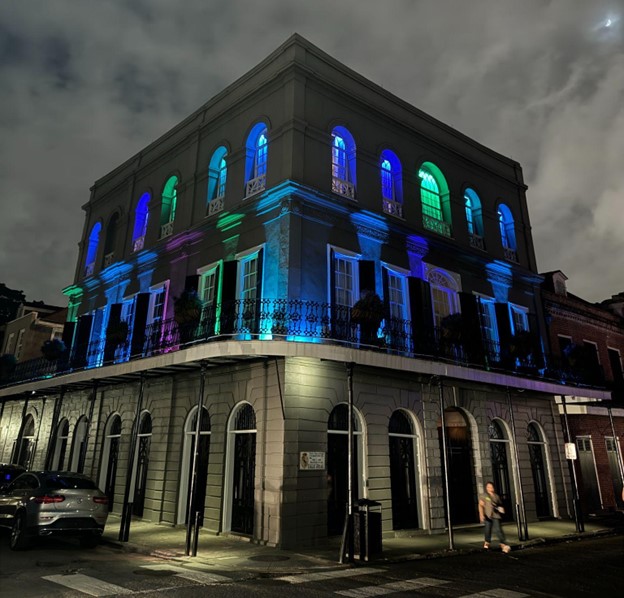
The LaLaurie Mansion – Copyright US Ghost Adventures
Bourbon Orleans Hotel
The Bourbon Orleans Hotel is a stately example of New Orleans’ elaborate architecture. A gorgeous illustration of the Belle Epoque style, it features a stunning mixture of historic details, Parisian luxury, and ornate features inside and out. Yet, like many feats of New Orleans architecture, this striking hotel had many prior faces.
Once home to the Orleans Theatre, this site ushered in elite Creole audiences to European operas and other performances. An undertaking that began in 1806 and took nearly 10 years to finish, it was soon destroyed by fire. Rebuilt with an added ballroom, the new theatre was designed by Henry Latrobe, the architect behind the U.S. Capitol. Decades later, it would be acquired by the Sisters of the Holy Family and remade into a convent.
Beneath its contemporary surface, the Bourbon Orleans Hotel houses many ghost stories. Tales are told of spectral nuns and their young wards still lingering. Others have spied a ghostly dancer in the restored ballroom. Even Confederate soldiers are rumored to stop in every now and again. All are seemingly still drawn to the grandeur of this majestic building.
Andrew Jackson Hotel
Found in the French Quarter on Royal Street, the Andrew Jackson Hotel is widely known in the Crescent City for both its old-world appearance and highly haunted history. Bordered by 18th-century European designs paired with a Creole-influenced patio and garden, its elegance conceals a tragic past.
The site of the Andrew Jackson Hotel harbors a strange history. Its first incarnation began in 1792, as an orphanage for boys left parentless by Yellow Fever. But more tragedy was to come; a deadly fire in 1794 devoured not just the building, but five boys inside. Afterward, a Federal Courthouse was built in its place, only to be razed in the late 1800s.
The structure that now looms over Royal Street dates back to 1890, although the spirits inside are far older. One of the boys is known to wake guests from their slumber with laughter or prankishly shove them out of bed. Others say they’ve spotted the orphanage’s old caretaker, tending to the guest rooms as they once did in life.
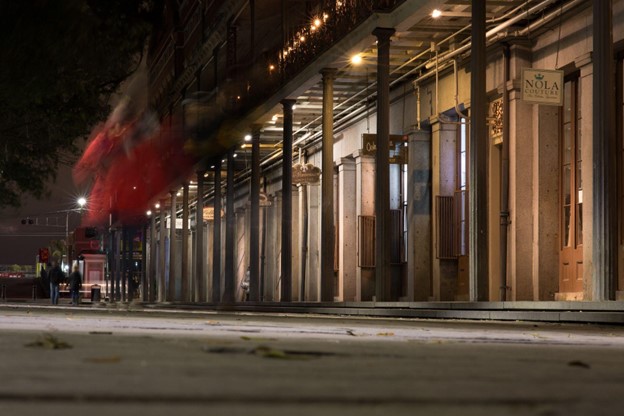
The beautiful French Quarter – Copyright US Ghost Adventures
Other Homes of the French Quarter
The architecture of New Orleans’ French Quarter is a striking blend of styles, leading to a signature flavor all of its own. A marriage of Creole, Spanish, French, and American influences, its diverse character spans from balcony-adorned townhomes to Creole cottages. Of the many remarkable properties in the French Quarter, several are also known to be haunted.
Faulkner House
The Faulkner House, found on Pirate’s Alley, showcases the Greek-revival style along with its signature shuttered windows and wrought-iron balconies. Built in 1840, this historic site is where William Faulkner penned his first novel, Soldiers’ Pay. Today, a bookstore, pipe tobacco is known to waft through the novel-lined aisles, and the famed author himself has been witnessed writing at his desk in ghostly form.
Hermann-Grima House
The Hermann-Grima house on St. Louis Street is another haunting abode. Constructed in 1831 and exemplary of the Federalist style, it contains the only original, undamaged stable in the French Quarter. Restored and open for tours, its ghosts are known to be quite amenable.
The presence of the ghostly Grima family is recognized by a floral smell, spreading warmth throughout the home. If a chill is ever felt inside, it’s likely due to one of the phantom Union soldiers who wander through every now and again.
Napoleon House
One cannot forget the 1800s-era Napoleon House, so named because it was offered to Emperor Napoleon as a sanctuary during his exile, according to local lore. Yet, despite its octagonal cupola, hipped roof, and striking arched dormers, its ghosts seem to care little for its mix of Beaux Arts and French Colonial details.
Previously a hospital during the Civil War, a Confederate soldier has been sighted patrolling the second-floor balcony in what is now one of the Crescent City’s most respected eateries, along with other spirits.
Crescent City’s Historic Garden District
You’ll find many hauntingly beautiful homes in the Historic Garden District of New Orleans. Numerous examples of Antebellum architecture are spread throughout this moss-draped neighborhood, just a stone’s throw away from one of New Orleans’ most haunted cemeteries.
A common stop on many New Orleans ghost tours, the Lafayette Cemetery #1 is soaked with mystery and captivating architecture, featuring New Orleans’ iconic above-ground crypts. Home to Civil War Soldiers, historic figures, and entire families stricken dead by yellow fever, it is well-known for its otherworldly presence.
Found steps away from this crumbling burial ground, lie architectural jewels like the grandiose Women’s Opera Guild House, a spectacular example of how Italianate and Greek Revival-style can be blended in grandiose columns and cast-iron balustrades.
The Briggs-Staub-Ripley House, one of a small handful of Gothic Revival homes in New Orleans, is yet another dramatic mansion. Adorned with pointed arches and lancet windows, it harbors the atmosphere of a Gothic castle. One might wonder if it draws the attention of the neighboring specters with its curious appearance, inviting them to cross the threshold.
A Haunting Legacy of Beauty and Tragedy
New Orleans has weathered countless misfortunes through its history, with illness and fire having brought many a soul to an early grave. But this resilient community has taken each tragedy as an opportunity to rebuild, leaving them with the perfect medley of unique architecture and spine-tingling ghost stories to entice travelers to this spirited destination.