
The René Magritte Museum in Brussels: Defiance of Tradition
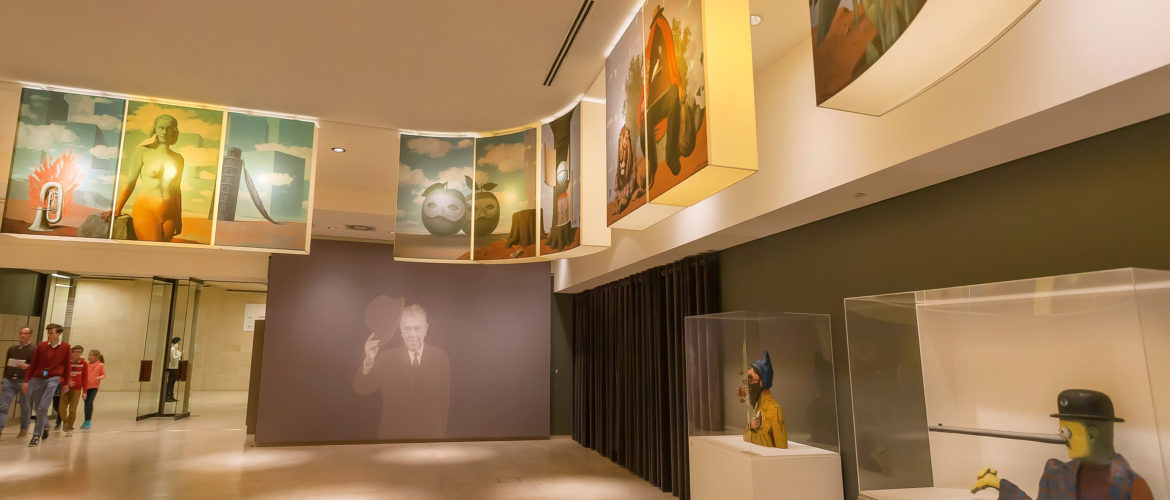
Most contemporary museums follow a familiar script when organizing exhibitions of specific artists or styles. They try to give some order or categorization to the displayed artwork, be it thematic or chronological. Art objects are placed against neutrally painted walls, and minimal sensory stimulation or interpretation is offered beyond the art. Yet, things are completely different with the René Magritte Museum in Brussels, Belgium. Here are some interesting details about how this museum defies tradition and gives an alternative view of Magritte’s artistic legacy.
What Is Unique about the René Magritte Museum?
The formula for René Magritte’s art presentation in Brussels goes beyond the standard formula and departs from the linear historical progression of his creative portfolio. Instead, the museum’s curators offer a unique visitor journey built around ideas and perception, inviting everyone to a tour of Magritte’s unique approaches to intellectual engagement.
You won’t find a year-by-year account of René Magritte’s creative labor; each display room is structured around concepts recurring throughout the artist’s work, such as the instability of reality or mystery behind ordinary, routine objects. This curatorial solution changes the visitor’s role from passive observation to active participation and interrogation, thus allowing them to rethink and question Magritte’s art.
Context-Specific Art Display
The staple of art exhibition planning is completeness and coherence. Yet, at the René Magritte Museum, this rule is broken by placing the artist’s sketches, letters, photographs, and commercial artwork alongside iconic, world-famous masterpieces. This approach creates a lively documentary of Magritte’s life without diminishing the value of any of his activity spheres. Besides, it makes the presentation of the artist’s work deeply human without elevating him onto a pedestal and transforming him into an unreachable icon.
Resistance to Spectacle
Magritte repeatedly noted that meaning should emerge through reflection, not theatrical distraction. Thus, the idea of resisting spectacle and stimulating intellectual and reflective insight is embodied in the minimalist design of his museum in Brussels. Visitors won’t find immersive digital projections or dramatic curated installations that aim to enhance the visual and emotional impact of the exhibition. Instead, only René Magritte’s works are given centrality amid the restrained interior design and a calm, analytical atmosphere welcoming introspection and intellectual dialogue.
Seemingly chaotic thematic organization allows visitors of the René Magritte Museum to navigate spaces on their own, skipping some ideas and stopping on others. Such an approach ensures a deeply personal encounter with Magritte’s art, turning into an open-ended conversation on the subjects the artist explored in depth.