
The Unexplored Marc Chagall: Stained Glass Art Masterpieces

Most of the world knows Marc Chagall for his paintings. The magical world of flying lovers and dreaming cows is the iconic, recognizable imagery shaping art connoisseurs’ perception of Chagall’s art portfolio. However, his late work with stained glass is also a notable part of the artist’s creative legacy.
A Late Calling
Marc Chagall had never worked with stained glass before he turned almost 70. The shift of the artist’s attention coincided with his increasing interest in the architecture of sacred places. Chagall started experimenting with light reflections in glass after his permanent settlement in southern France in 1950, inspired by the Mediterranean vividness of colors and brightness. The first stained-glass artwork was created on commission for the church of Assy, seeing the world in 1956. That commission came from Father Couturier, a Dominican monk working on religious revival in post-war France.
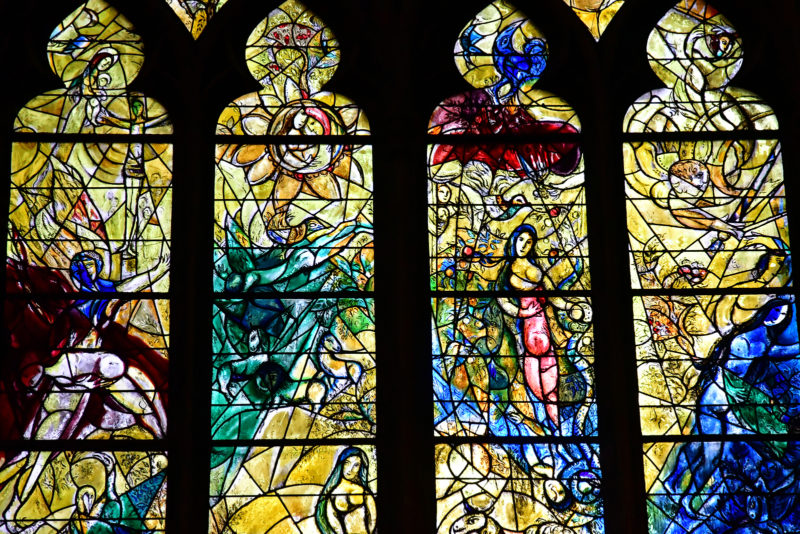
The Jerusalem Windows by Marc Chagall
What started at Assy opened a new phase in Chagall’s creative path, spanning almost three decades of tireless work on stained-glass projects. One of the most notable and famous creations of that period is the Jerusalem Windows – 12 stained-glass panels installed in the Abbell Synagogue of the Hadassah Medical Center in 1962. This project represents Chagall’s tribute to his Jewish legacy, with each of the twelve panels representing 12 tribes of Israel.
Work on the Jerusalem Windows lasted for years, with Chagall partnering with the experienced glassmakers, Charles Marq and Brigitte Simone-Marq, to bring his idea to life. Trial panels were taken to the synagogue for light correction before the final variant was produced. Chagall presented the art object as a gift to the synagogue, accepting no payment in return.
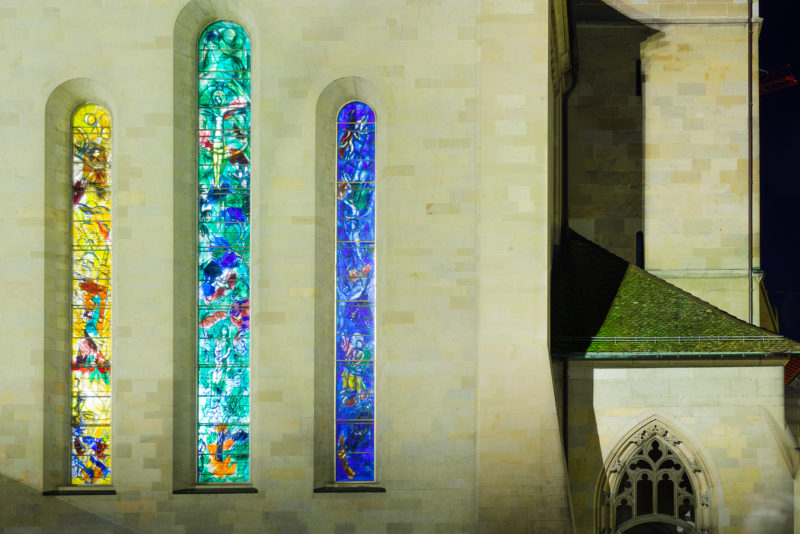
Chagall and Christian Sacred Art
The fact that a Jewish artist from Belarus played a vital role in Christian art of the 20th century would perplex many. However, the legacy of Marc Chagall is outstanding; his windows can be found in the Saint-Etienne Cathedral in Metz, the Reims Cathedral, and many other religious buildings across Europe. For example, cathedrals in Zurich and England are adorned with Chagall’s towering windows, communicating the artist’s light philosophy and creative vision across generations.
Chagall’s stained-glass art is not exclusive to religious objects. The “Peace Window” of his authorship embellishes the UN headquarters in New York, symbolizing the globally unifying humanity. The artist also created windows for the Art Institute of Chicago as a tribute to artistic freedom and creativity.