
Marcel Duchamp: The Invisible Grammar of Contemporary Art

In 1959, Jasper Johns created Painted Bronze, a sculpture of two Ballantine Ale cans cast in bronze and carefully painted. Many interpreted the work as a tribute to Marcel Duchamp, whose radical ideas had redefined what could be considered art. Duchamp argued that the meaning of an ordinary object shifts entirely depending on its context, placement, and the viewer’s perception.
When Johns met Duchamp, the latter responded warmly to Painted Bronze. This moment reflects Duchamp’s evolution—from an artistic provocateur to a foundational thinker whose ideas reshaped modern and contemporary art.
Duchamp’s Philosophy of Readymade Art
Duchamp’s most famous public statement came in 1917 at the exhibition of the Society of Independent Artists, where he submitted a urinal signed “R. Mutt,” later known as Fountain. The controversial art piece shocked the art world, challenging deeply held assumptions about creativity and authorship.
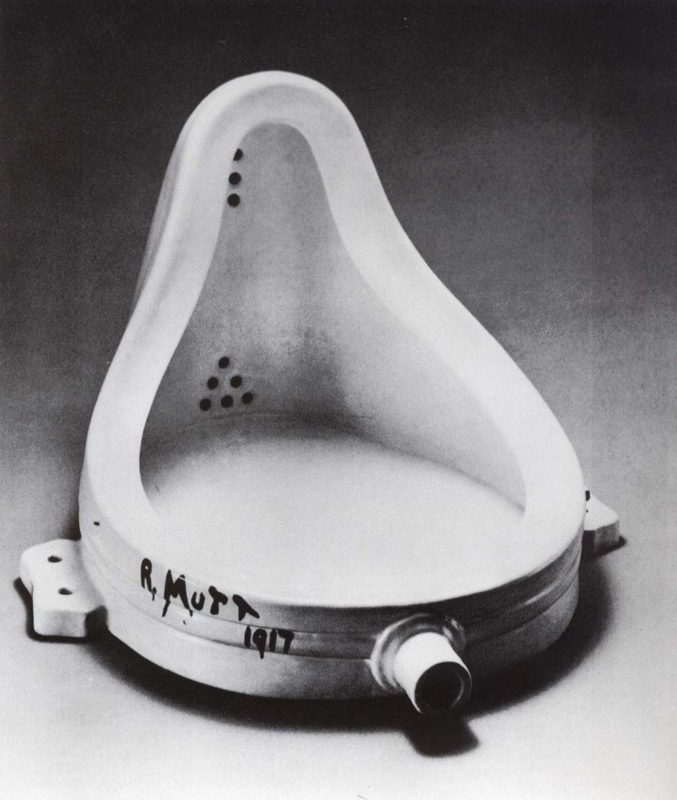
By selecting a manufactured object, removing it from its usual context, and presenting it as art, Duchamp posed a provocative question: is artistic intention alone enough to transform an object into art? This idea—unsettling yet powerful—redefined the boundaries between the everyday and the aesthetic.
Marcel Duchamp’s influence quickly spread among postwar artists. Robert Rauschenberg explored similar ideas in his Combines, merging painting with found objects. Andy Warhol further blurred the line between art and consumer culture with his Brillo boxes and Campbell’s soup cans.
In the 1960s, conceptual artists such as Lawrence Weiner, Joseph Kosuth, and Sol LeWitt advanced Duchamp’s ideas by prioritizing concept over object. Art, in their view, could exist as an idea alone—an approach Marcel Duchamp had anticipated decades earlier.
Marcel Duchamp and the Anti-Object
The Fluxus movement of the 1960s pushed Marcel Duchamp’s logic even further. Artists like Yoko Ono, George Maciunas, and Nam June Paik created ephemeral, performative works that resisted ownership and permanence. Their art existed only in the moment, embodying Duchamp’s notion of the “anti-object.”
Duchamp’s influence also extended to Minimalism and Arte Povera. Artists such as Donald Judd and Carl Andre employed industrial materials and simple forms, emphasizing idea and structure over traditional aesthetics.
Ultimately, Marcel Duchamp’s legacy lies not in a single object, but in a fundamental shift in how art is understood. By challenging established conventions and asserting the primacy of the artist’s choice, he introduced an “invisible grammar” that continues to shape contemporary artistic practice.