
A Painter Behind the Story: The Fascinating Life of Lili Elbe

The name of Lili Elbe is now most commonly associated with the bestselling novel by David Ebershoff and the 2015 Oscar-nominated film inspired by her life. However, few people can name even one of her paintings. As a result, Elbe has become a figure known to millions, while her artistic legacy remains surprisingly overlooked. Yet long before her story reached the big screen, she had established herself as a talented landscape painter whose works deserve renewed attention.
Early Years of the Artist
The Danish painter Einar Wegener, later known as Lili Elbe, was born in Vejle in 1882 and was assigned male at birth. By modern convention, biographical accounts refer to Elbe using feminine pronouns. She received formal artistic training at the Royal Danish Academy of Fine Arts in Copenhagen beginning in 1902. During her studies, she met illustrator Gerda Gottlieb, whom she later married.
Elbe painted in a recognizable Nordic Post-Impressionist style while gradually developing her own artistic voice, especially after moving to France. Her early landscape paintings featured recurring views of the countryside around Vejle, including Mølholm, Skrædderbakken, and the scenery overlooking Munkebjerg and the fjord. Dominated by muted greens, browns, and grays, these works reflected the traditions of Danish naturalism while revealing the artist’s subtle personal style.
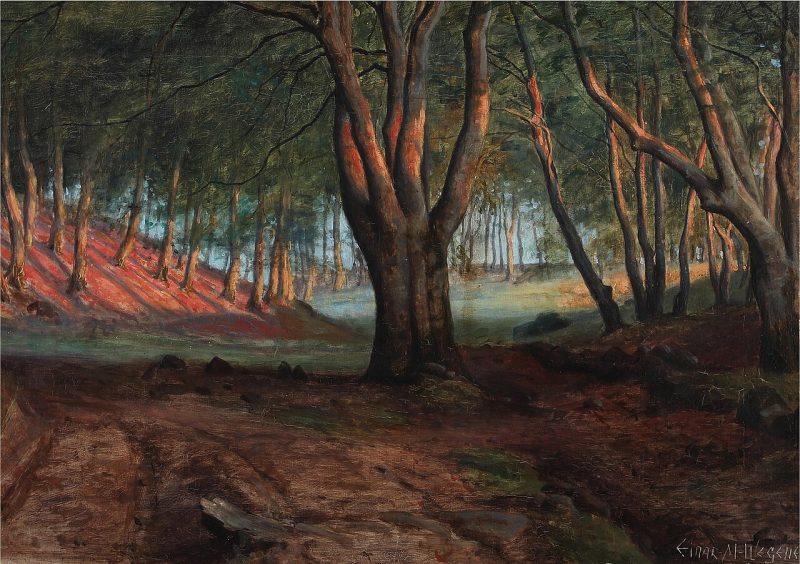
Lili Elbe, Forest Scene with Golden Sunlight (1905). This painting was made while the artist still called herself Einar Mogens Wegener.
Painting Legacy of Lili Elbe
In 1907, Elbe received the prestigious Neuhausens Prize, one of Denmark’s leading awards for painters. Her works were exhibited at Kunstnernes Efterårsudstilling (the Artists’ Autumn Exhibition) and at the art museum in her hometown. In 1912, Elbe and Gerda Gottlieb settled in Paris, where the artist exhibited at the Salon d’Automne.
The paintings created in France reveal a warmer palette and a more stylized approach, often depicting poplar-lined roads, quiet villages, and peaceful rural landscapes. Today, the Vejle Art Museum preserves around 80 of Lili Elbe’s paintings, while her known artistic legacy exceeds 100 works. As interest in Elbe continues to grow, her paintings are receiving increasing recognition from museums, collectors, and art historians.
The Premature End of an Artistic Career
Art historians still debate why Lili Elbe abandoned landscape painting so suddenly. One theory suggests that leaving painting behind was closely connected to her gender transition, symbolizing a departure from her previous identity. Others believe she stepped away from her own career to support Gerda Wegener’s growing success, often posing as her model.
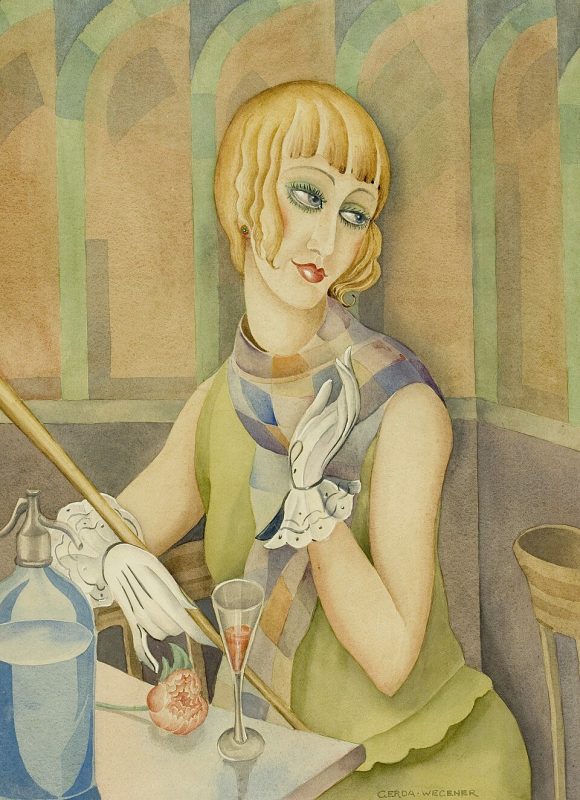
Gerda Wegener, Portrait of Lili Elbe (ca. 1928).
Elbe is also believed to have contributed backgrounds and decorative details to some of Gerda’s paintings. However, this collaborative work remains poorly documented and cannot be considered part of her independent artistic legacy. Although her painting career was relatively brief, Elbe left behind a body of work that reflects both technical skill and a distinctive vision, making her an important yet often underappreciated figure in early 20th-century art.
Featured image: Lili Elbe, A landscape scenery from Mølholm near Vejle (1900). This painting was made while the artist still called herself Einar Mogens Wegener.