
Fixation on Death as a Key Feature of Art by Damien Hirst

Damien Hirst is a fashionable contemporary artist whose paintings, sculptures, and installations possess a unique, controversial appeal because of their fixation on death and mortality. His art is instantly recognizable for the provocative display of death symbols and the metaphorical reinterpretation of people’s illusion of control.
Subjectification of Death
Contrary to the tradition of depicting death sentimentally, metaphorically, or euphemistically, Hirst turns it into a literal, tangible object. His iconic 1991 work titled “The Physical Impossibility of Death in the Mind of Someone Living” remains one of the most recognizable art objects in the world. It features a tiger shark, the deadliest animal in the world, preserved in a reservoir with formaldehyde. The shark’s intact condition, free from signs of death or decay, turns it into a suspended menace, which viewers can safely encounter and contemplate.
Another vivid example of Hirst’s treatment of death is the 2007 artwork “For the Love of God,” representing a platinum skull covered with diamonds. This ultra-expensive, luxurious art object turns death into a subject that can be marketed as a luxury asset, thus offering an unsettling view of human existential fears packed into prestigious wrapping.
Medicine and Death Control in the Work of Damien Hirst
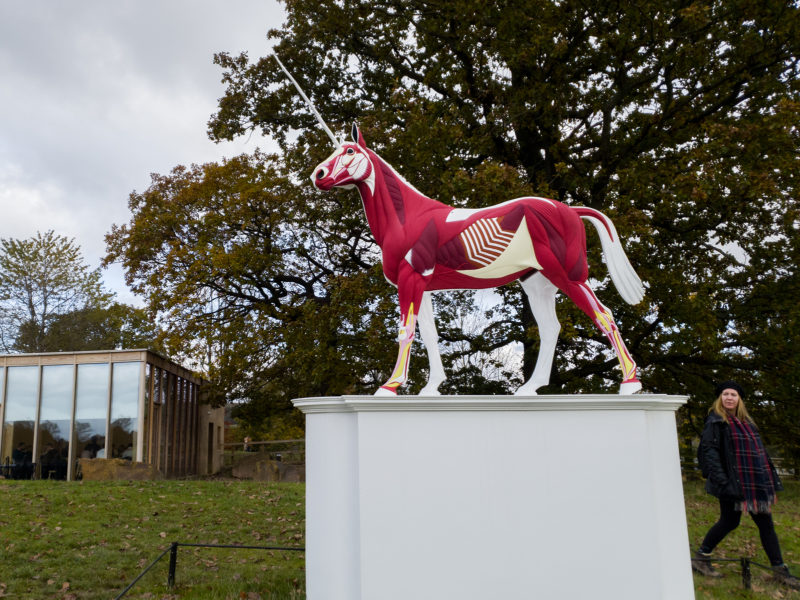
Another part of Damien Hirst’s art portfolio is the creatively reinterpreted medical imagery. These art objects reveal the artist’s approach to institutional efforts of death control and human reliance on pills, surgery, and other methods to mute the collective anxiety and postpone the unavoidable. Hirst approaches this subject with rigid structural grids and sterility, showing how people’s faith in medicine serves as reassurance while exposing human fragility at the same time.
The Richest Living Artist in the UK
While death is scary and unclear to many, it has proven remarkably popular and marketable when elevated to a state of art. This long-standing human interest in death and mortality, transcending the boundaries of culture and epochs, has made Damien Hirst the richest living artist in the UK. According to the 2020 Sunday Times Rich List, his wealth exceeded $384 million, proving that Hirst’s provocative art enjoys high market demand. Experts note that the artist’s unique appeal is in selling the unavoidable and translating human existential fears into tangible objects with an illusion of reassurance. There is no spiritual reassurance in his work. Instead, it is the ability to give viewers a safe image of death, allowing contemplation from the outside, that distinguishes Damien Hirst’s art and gives it stable popularity.